Every throw uses a ball
Plain balls are the basic throw, Great Balls are 1.5 times as likely, Ultra Balls twice. A catch pays you 10 coins a level, so a good catch roughly pays for its ball.
Should catches pay coins at all?
Give feedback
One wild creature in 1,024 is shiny
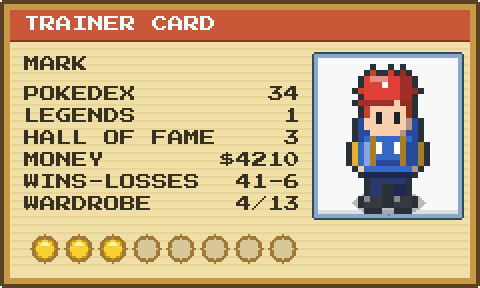
A shiny comes in its own colours, with a sparkle beside it and a ✨ by its name, and a shiny encounter opens with “✨ A shiny Pidgey appeared!” It's no stronger than any other. It stays shiny when you catch it and when it evolves, your server hears when you catch one, and your trainer card counts the shinies you own.
Is 1 in 1,024 rare enough to feel special, but common enough that you'll meet one?
Give feedback
You carry six, and the box holds everything else
Anything you catch with six already in your party goes to your box, and the box has no limit. A cap would only make you let creatures go to make room. The Party button swaps creatures between party and box whenever you're out of battle. They go as they are, so the box won't heal them.
Would you ever want to release a creature, or trade one away for good?
Give feedback
Everyone who fought shares the experience
Like Red and Blue: every creature that was out against a foe and is still standing splits its experience evenly, and catching one gives the same experience as knocking it out. The third gym leader hands you the Exp. Share, and from then on the rest of your party takes half as well. It's part of that world's run, not something you keep: nothing permanent makes you better at the game.
Is the third badge the right time for the Exp. Share?
Give feedback
No two creatures are quite alike, and they grow by what they beat
Like the later games. Every wild creature, and your starter, has a nature: most raise one stat by a tenth and lower another, a few do neither. It also has potential, 0 to 31 in each stat, which your party screen grades S to D. Both are fixed for life, so a second Pidgey can be a better Pidgey. Beating a creature trains everyone who earns experience from it in the stat its species teaches: a Pidgey teaches Speed, an Onix Defense. That's up to 252 in a stat and 510 in all. Trainers' creatures have more potential the higher up the trainer: the Elite Four have the most.
Is this fun to chase, or too much to keep track of?
Give feedback
Swap creatures whenever you like, for a turn
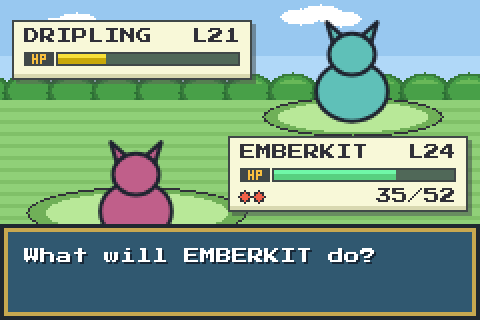
Call one back and send another out. It costs your turn, like using an item, and the other side gets a free hit on whoever comes in.
Is a free hit on the newcomer too harsh?
Give feedback
Gym leaders and champions switch back
Gym leaders, everyone in a villain hideout or guarding a shrine, the Elite Four and Hall of Fame champions read your creature's type. If it hits theirs hard, they call it back for one that takes it better, and when one falls they send out whichever suits the fight. Their ace always comes out last. They see your switch a turn late, and they never guess: the same position gets the same answer. Route and gym trainers send theirs out in order.
Should ordinary trainers switch too, or is that best kept for the big fights?
Give feedback
Beating wild creatures pays a little
Three coins a level. Trainers are the real money, but once you've beaten them all there needs to be some way to afford balls again.
Is grinding wild creatures for coins something you'd do?
Give feedback
Poison, burns, paralysis, sleep and freeze last until they're cured
A creature has one at a time, and it carries it from battle to battle until a Centre, a cure from the bag or a berry fixes it. Fire types can't be burned, electric types can't be paralysed, and so on. Poison doesn't hurt between battles, because there's no walking. A sleeping or frozen creature is twice as easy to catch.
Should poison bite between battles, the way it did with every step in Red and Blue?
Give feedback
Growl, Swords Dance and Confuse Ray are in
Creatures learn their status moves as well as their attacks. Stat changes go up to six steps either way and wear off when it's called back. Confusion wears off after a few turns and sometimes makes it hit itself. Attacks like Bite can make the target flinch.
Do opponents using Growl and Tail Whip slow battles down too much?
Give feedback
One hit in 24 is a critical hit
A critical hit does half as much again, and ignores the attacker's lowered Attack, the target's raised Defense and any screen. Slash, Razor Leaf and the like land them one time in eight. This is the later games' rule; in Red and Blue fast creatures crit far more.
Do critical hits feel fair, or just random?
Give feedback
Recover, Rest, Giga Drain and Leech Seed are in
Recover and its like heal half your HP. Rest sleeps for two turns, cures whatever ailed it and wakes at full HP; hold a berry that cures sleep and it wakes at once. Draining moves heal half of what they deal, and Take Down and Double-Edge cost recoil. Leech Seed saps an eighth of the target's HP each turn for whoever is out on your side. Grass types can't be seeded. Dream Eater only works on a sleeping target. Stockpile stores up to three and toughens you as it does; Spit Up hits harder and Swallow heals more for each one stored, and both use them all up.
Does Recover make battles drag?
Give feedback
Screens and weather last five turns
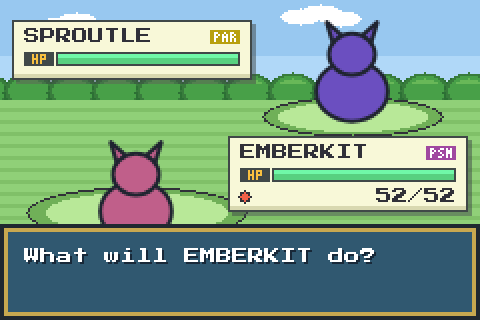
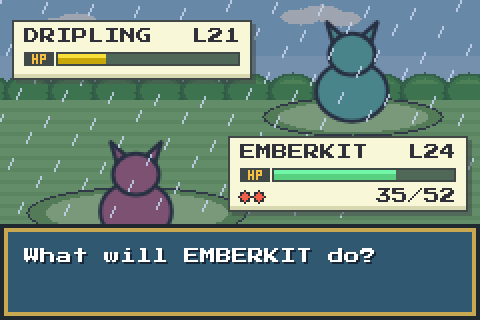
Reflect halves physical damage to your side and Light Screen halves special, and they stay up if you swap. Rain powers up water moves and weakens fire ones, and harsh sun does the reverse. Sandstorm and hail chip everyone a sixteenth a turn, except rock, ground and steel types in sand and ice types in hail. Snow, from the newest games, hurts nobody but toughens ice types' Defense, and a sandstorm toughens rock types' Special Defense. Red and Blue had no weather, so in a Kanto world only abilities bring it. You can see it, too: rain falls, sand blows and snow drifts across the battle picture.
Would you build a team around weather?
Give feedback
Quick Attack goes first
Some moves jump the queue whatever the speed: Quick Attack, Extreme Speed, Aqua Jet. A few, like Roar and Counter, always go last. Between two moves of the same kind, the faster creature goes first, as ever. Prankster puts its user's status moves ahead.
Do quick moves make slow creatures worth using?
Give feedback
Fury Attack, Wrap and Hyper Beam work like the later games
Moves that hit two to five times hit two or three times most often, and each hit can crit. Wrap, Bind and Fire Spin trap the target for four or five turns, taking an eighth a turn. A trapped creature can't run or swap, but it can still fight, unlike in Red and Blue. Hyper Beam costs you the next turn to recharge.
Is trapping annoying or fun when it's done to you?
Give feedback
Every creature has an ability
Each has one of its species' usual abilities, and keeps it when it evolves. One wild creature in twenty has its species' hidden ability instead, and your party screen marks it. Levitate dodges ground moves, Intimidate lowers the other's Attack as it comes out, Swift Swim doubles speed in rain, Static may paralyse whoever hits it, and so on. When one does something, the battle says so. Your party screen says what each one does. Around two in three do something here. The rest are for exploring or double battles, which this game doesn't have. Abilities that care about the kind of move work as in the games: Static only triggers on moves that make contact, Iron Fist powers up punches, and Soundproof blocks sound moves. Opponents know your ability too: they won't throw an electric move at a Volt Absorb.
Is one in twenty the right rate for hidden abilities?
Give feedback
Teach a move back whenever you like
With four moves full, a new one gets skipped, but it isn't lost. From the bag, a creature can swap any move it knows for one it's learned by its level. The new move takes over whatever share of PP the old one had left, so swapping isn't a free heal.
Should relearning cost something, like the Move Reminder did?
Give feedback
 Super Adventure